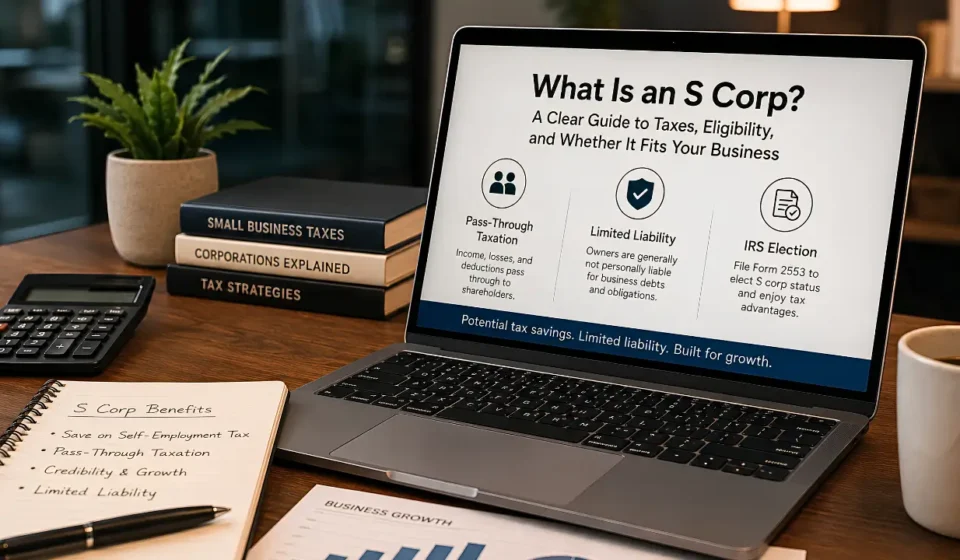

Choosing a business structure can feel confusing, especially when you hear that an S corporation may reduce taxes. The key point is that an S corp is not a standalone type of business entity it is a federal tax election that qualifying corporations and LLCs can make.
This guide explains what an S corp is, how S corporation taxation works, the IRS eligibility rules, potential advantages and drawbacks, and the practical steps to decide whether it makes sense for your U.S. business.
What is an S corp?
An S corporation, commonly called an S corp, is a business that has elected to be taxed under Subchapter S of the Internal Revenue Code. Its main feature is pass-through taxation: most business income, losses, deductions, and credits pass through to shareholders and are reported on their personal income tax returns.
Unlike a traditional C corporation, an S corp generally does not pay federal corporate income tax on its operating profits. The shareholders pay the applicable federal income tax instead, based on their ownership share.
An S corp election can be made by
- A corporation that meets the IRS requirements
- An LLC that elects to be taxed as a corporation first, then elects S corp status
- Certain other eligible domestic entities
The IRS requires an eligible entity to submit Form 2553, Election by a Small Business Corporation, to be treated as an S corporation.
Simple S corp example
Imagine a two-owner marketing agency in the United States earns $180,000 in net profit after normal business expenses.
If the agency is an S corp, each owner may receive:
- A reasonable salary for the work they perform
- A share of any remaining business profit as an S corp distribution
The salary is subject to payroll taxes. Remaining eligible profit can pass through to the owners’ individual returns and is generally not subject to self-employment tax in the same way as salary—although income tax still applies, and the details depend on the business and each owner’s situation.
This is why profitable owner-operated businesses often explore an S corp election. It is not an automatic tax-saving strategy, however. Payroll, tax preparation, state compliance, and reasonable-compensation rules can offset or outweigh the benefits for some businesses.
After Article Read To visit Least News
How does an S corporation work?
An S corp combines a legal entity’s liability protection with a specific federal tax treatment. The legal setup and tax election are related, but they are not the same thing.
Formation and legal protection
First, a business must be established under state law, usually as a corporation or LLC. This legal entity generally separates the owners from business liabilities.
In practical terms, that means a business creditor or claimant will usually pursue the company’s assets rather than an owner’s personal savings, home, or other personal property. That protection is not absolute: owners can still face personal liability for personal guarantees, fraud, negligence, unpaid employment taxes, or failure to keep company and personal finances separate.
Pass-through taxation
S corps generally use pass-through taxation. The company files an informational federal return, but its ordinary income typically passes to shareholders.
Each shareholder receives a Schedule K-1 showing their allocated share of income, deductions, and credits. Shareholders generally report that information on their individual federal tax returns, whether or not all profits were actually distributed in cash.
That last point matters. A shareholder can owe tax on allocated S corp profit even if the business keeps some of that cash in the company for inventory, equipment, payroll reserves, or growth.
Salaries and distributions
An owner who actively works for the S corp is usually both a shareholder and an employee. The business must pay that owner reasonable compensation before treating additional payments as distributions.
The IRS states that distributions and other payments to a corporate officer must be treated as wages to the extent they represent reasonable compensation for services performed.
For example, an owner cannot reasonably perform full-time management, sales, and client work while taking a token $10,000 salary and withdrawing $150,000 as distributions. The IRS may reclassify improperly labeled distributions as wages, potentially creating back payroll taxes, penalties, and interest.
S corp requirements and filing rules
Not every business can elect S corporation tax status. Before filing Form 2553, confirm that the company meets the federal requirements.
To qualify, an S corp generally must:
- Be a domestic corporation or a domestic entity eligible to be taxed as a corporation
- Have no more than 100 shareholders
- Have eligible shareholders, generally individuals, certain trusts, estates, and some tax-exempt organizations
- Have no nonresident alien shareholders
- Have only one class of stock, although voting rights can differ
- Avoid being an ineligible institution, such as certain banks, insurance companies, and domestic international sales corporations
- Obtain consent from all shareholders for the electionirs
When to file Form 2553
For a calendar-year business, Form 2553 is generally due no later than two months and 15 days after the beginning of the tax year the election should take effect. Alternatively, it may be filed during the preceding tax year.
For example, a business seeking S corp treatment beginning January 1 would ordinarily file by March 15 of that year. The IRS provides rules for late-election relief in some circumstances, but business owners should not assume relief will apply.
Ongoing filing obligations
After the election, an S corporation generally needs to:
- File Form 1120-S annually
- Provide Schedule K-1 forms to shareholders
- Run payroll for shareholder-employees who provide services
- File payroll tax returns and make employment tax deposits
- Maintain corporate records, meeting minutes where required, and separate financial accounts
- Meet state-level annual-report, franchise-tax, and registration requirements
Federal S corp status does not eliminate state taxes or state filing duties. State treatment varies widely. Some states follow the federal election, while others impose separate S corp taxes, franchise taxes, minimum taxes, or election requirements.
Benefits and disadvantages of an S corp
An S corp can be useful, but its value depends on profit, payroll, ownership plans, and administrative capacity.
| Potential benefits | Potential disadvantages |
| Avoids federal corporate-level tax on most operating income | Requires more paperwork, tax filings, payroll, and recordkeeping |
| May reduce employment-tax exposure on qualifying profits after reasonable owner salary | Owners who work in the business must receive reasonable compensation |
| Provides liability protection when paired with a properly formed LLC or corporation | Only eligible U.S. shareholders can own shares |
| Can support a more formal business structure and ownership arrangement | Limited to 100 shareholders and one economic class of stock |
| Allows business losses to pass through, subject to basis and other tax limits | Less flexible for venture capital, preferred shares, and broad investor ownership |
When the tax benefit may be meaningful
The S corp model often becomes more attractive when an owner-operated business has steady profit beyond what it needs to pay the owner a market-based salary and cover compliance costs.
For instance, a consultant earning modest profits may find that an LLC’s simpler administration is more economical. A consulting firm earning substantial, recurring profit after paying the owner a reasonable wage may have a stronger case for evaluating an S election with a CPA.
The point is not to force distributions or minimize salary at all costs. The goal is to use a valid structure that reflects the business’s real operations.
When an S corp may be a poor fit
An S corp may be less suitable when a company expects to:
- Raise institutional venture capital
- Issue preferred shares or create complex investor rights
- Have foreign investors or corporate owners
- Retain earnings aggressively for expansion
- Operate with inconsistent or low profit
- Avoid payroll and annual compliance work
Businesses planning rapid fundraising often prefer a C corporation because it offers more flexibility in share classes and investor eligibility.
S corp vs. LLC vs. C corporation
An LLC, S corp, and C corp are often compared as though they are three identical categories. They are not.
An LLC is a legal entity created under state law. An S corp is a federal tax classification. A C corporation is generally both a legal corporate structure and the default federal tax treatment for corporations.
| Feature | LLC | S corporation | C corporation |
| Legal form | State-law entity | Tax status for an eligible corporation or LLC | State-law corporation with default tax treatment |
| Federal tax treatment | Usually pass-through by default | Usually pass-through | Corporation pays tax; dividends may be taxed again to shareholders |
| Owner restrictions | Broad flexibility | Up to 100 eligible shareholders; no nonresident alien shareholders | Generally broad ownership flexibility |
| Stock classes | Flexible membership interests | One economic class of stock | Multiple classes, including preferred stock |
| Owner payroll | Members may owe self-employment tax on business income | Active shareholder-employees need reasonable wages | Working shareholder-employees receive wages |
| Best suited for | Simplicity and flexibility | Profitable qualifying small businesses | Businesses seeking outside investment or complex equity structures |
An LLC can elect S corp taxation without converting into a corporation under state law. That distinction is useful for many small businesses: they can retain the LLC’s legal framework while adopting an S corp tax election if eligible.
Common S corp mistakes to avoid
The most expensive mistakes tend to come from treating an S corp as a tax label rather than an operating business with compliance responsibilities.
- Paying an unreasonably low owner salary to maximize distributions
- Missing the Form 2553 deadline or failing to secure shareholder consent
- Adding an ineligible shareholder, such as a nonresident alien or another corporation
- Creating unequal distribution rights that violate the one-class-of-stock rule
- Mixing personal and company finances
- Forgetting that shareholders can owe tax on profit that was retained in the business
- Ignoring state filings, annual reports, payroll taxes, or franchise taxes
- Assuming every dollar distributed is tax-free without considering shareholder stock basis
Maintain clean books, document major business decisions, use a dedicated bank account, and work with a qualified tax professional who understands S corp payroll and shareholder basis.
What is the meaning of an S corp?
An S corp is a business that has elected a special federal tax status under Subchapter S of the Internal Revenue Code. It usually passes income, deductions, losses, and credits through to shareholders’ personal tax returns rather than paying federal corporate income tax at the business level.
What makes you an S corp?
You become an S corp by forming or operating an eligible domestic corporation or LLC, meeting IRS ownership and stock requirements, getting shareholder consent, and filing Form 2553 with the IRS.
Which is better: a C corp or an S corp?
Neither is universally better. An S corp often works well for qualifying U.S. small businesses with consistent profit and owner involvement. A C corp is often better for companies seeking venture capital, foreign investors, multiple stock classes, or more flexible equity arrangements.
Can an S corp own 100% of a C corp?
Generally, yes. The S corp eligibility rules restrict who may own the S corporation; they do not generally prohibit an S corporation from owning stock in a C corporation. However, the ownership structure can create tax, accounting, and legal complexities, so obtain professional advice before setting it up.
Does an S corp avoid all taxes?
No. S corp shareholders may still owe federal and state income tax on passed-through income. The business also pays payroll taxes on employee wages, including reasonable compensation paid to working shareholder-employees.
Is an S corp right for your business?
An S corp can offer valuable pass-through tax treatment and potential payroll-tax efficiency for a profitable U.S. small business. But it also brings eligibility limits, payroll requirements, annual filings, and more formal administration.
Before making the election, estimate your expected profit, determine a defensible owner salary, compare the savings against added compliance costs, and ask a CPA or enrolled agent to model the result for your specific facts. Then read a related guide on LLC vs. S corp taxation to decide whether an S election supports your next stage of growth.
Sources