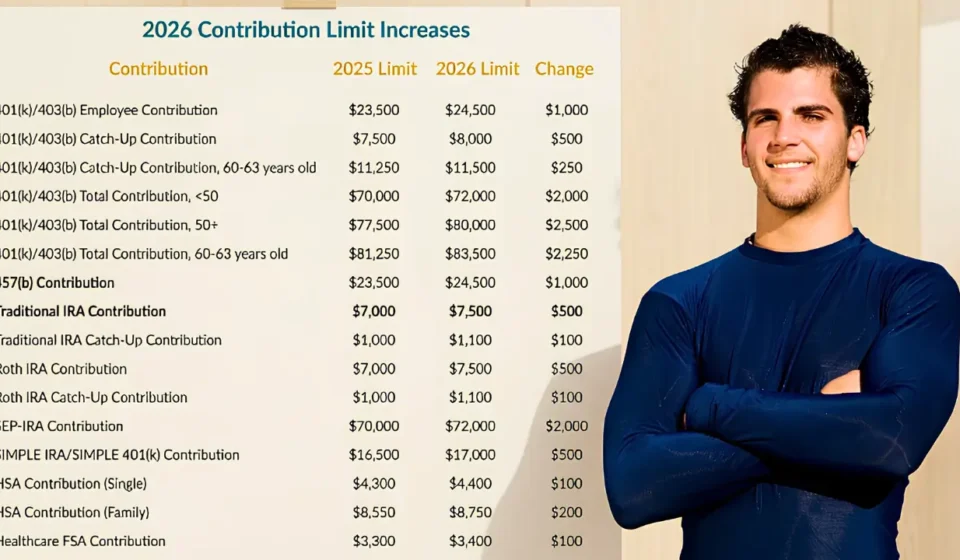

A higher contribution limit gives many Americans more room to build tax-free retirement income—but income rules can reduce or eliminate eligibility. For 2026, the Roth IRA limit rises to $7,500, or $8,600 for people age 50 and older. Here’s how the limits, income thresholds, marriage rules, and workplace plans fit together.
2026 Roth IRA contribution limits
For the 2026 tax year, you can contribute up to:
- $7,500 if you are under age 50.
- $8,600 if you are age 50 or older, including the $1,100 catch-up contribution.
- Your total contribution cannot exceed your taxable compensation for the year if that amount is lower.
The limit is shared across all of your traditional and Roth IRAs. For example, if a 35-year-old contributes $5,000 to a traditional IRA, they can contribute only another $2,500 to a Roth IRA for 2026—not $7,500 more.
After Article Read To visit Least News
Roth IRA income limits 2026
Eligibility is based on modified adjusted gross income (MAGI), not simply the salary shown on your W-2. MAGI can differ because of certain deductions, exclusions, or investment income.
| Filing status | Full contribution | Reduced contribution | No direct contribution |
| Single or head of household | Below $153,000 | 153,000–168,000 | $168,000 or more |
| Married filing jointly | Below $242,000 | 242,000–252,000 | $252,000 or more |
| Married filing separately, if you lived with spouse | $0 | 0–10,000 | $10,000 or more |
If your income falls within the phase-out range, you may still make a partial Roth IRA contribution. The permitted amount declines as your MAGI approaches the upper end of the range.
Roth IRA limits for married couples
For married couples filing jointly, each spouse can potentially contribute up to their own annual maximum. That means a couple where both partners are 50 or older could contribute up to $17,200 combined in 2026, provided their household MAGI is below $242,000 and they have enough taxable compensation.
A spouse without earned income may still qualify through a spousal IRA contribution when the couple files jointly and the working spouse has sufficient taxable compensation. This can be especially useful when one partner pauses work for caregiving, education, or a career transition.
Can you contribute with a 401(k)?
Yes. Having a 401(k) at work does not prevent you from contributing to a Roth IRA. The accounts have separate contribution limits: the 2026 employee 401(k) deferral limit is $24,500, while the IRA limit is $7,500 before catch-up contributions. Your Roth IRA eligibility still depends on MAGI.
For example, a 42-year-old earning $120,000 could contribute to a workplace 401(k) and, assuming their MAGI remains below the threshold, fully fund a Roth IRA as well.
Roth IRA contribution limits 2026 vs. 2025
The standard IRA contribution limit increased by $500, from $7,000 in 2025 to $7,500 in 2026. The age-50-plus maximum rose from $8,000 to $8,600. Income phase-out ranges also increased:
- Single and head-of-household filers: from 150,000–165,000 to 153,000–168,000.
- Married couples filing jointly: from 236,000–246,000 to 242,000–252,000.
Next step
Check your expected 2026 MAGI before automating contributions, especially if you are near an income phase-out threshold. Then consider reading a related guide on calculating Roth IRA eligibility or speaking with a qualified tax professional before using strategies such as a backdoor Roth IRA.
What is the Roth IRA limit for someone over 60 in 2026?
The limit is $8,600. There is no additional Roth IRA contribution increase specifically at age 60; the standard IRA catch-up begins at age 50.
Can married couples each have a Roth IRA?
Yes. Roth IRAs are individual accounts, so each spouse needs their own account. A qualifying couple may contribute to both accounts, subject to the joint income limits.
What happens if I contribute too much?
An excess contribution can trigger a 6% annual excise tax until corrected. Contact your IRA provider or tax professional promptly to discuss removing or recharacterizing the excess.
Sources